
Lagrangian Drifters
Ocean Currents - Product - 1 km to ocean basin
Low-cost drifters for mass deployment, delivered with satellite subscription, data processing, and support.
Overview
The drifters send their position at regular intervals via satellite. You follow them on a live map. After the campaign we run quality control and hand over the dataset. We handle data licenses, activation and deactivation, and guide you through deployment.
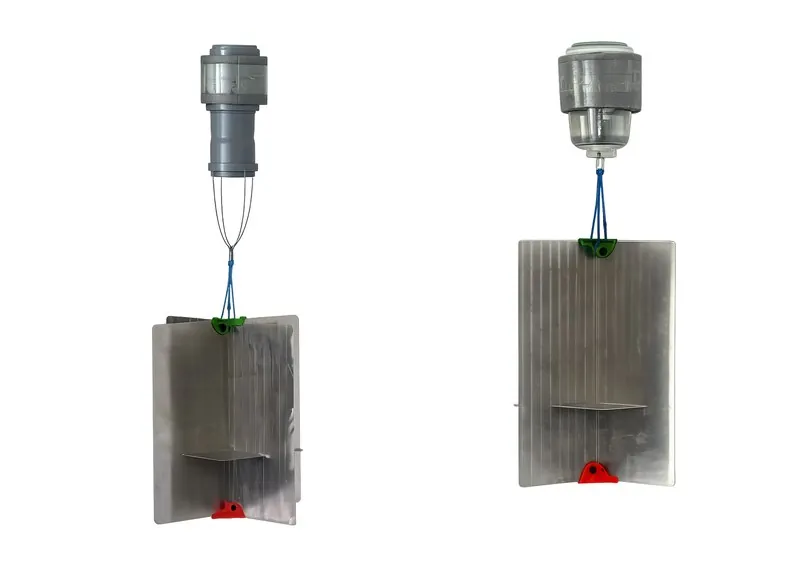
We offer two versions:
- HLD-1 - Standard version with plastic housing
- HLD-2 - Version with glass housing and significantly less plastic
Both versions share the same specifications and data services. HLD-2 was developed to minimize environmental impact and was deployed in The Ocean Race Europe 2025.
On request we plan deployment positions, help avoid fishing activity, and estimate drift for your area of interest.
What you see
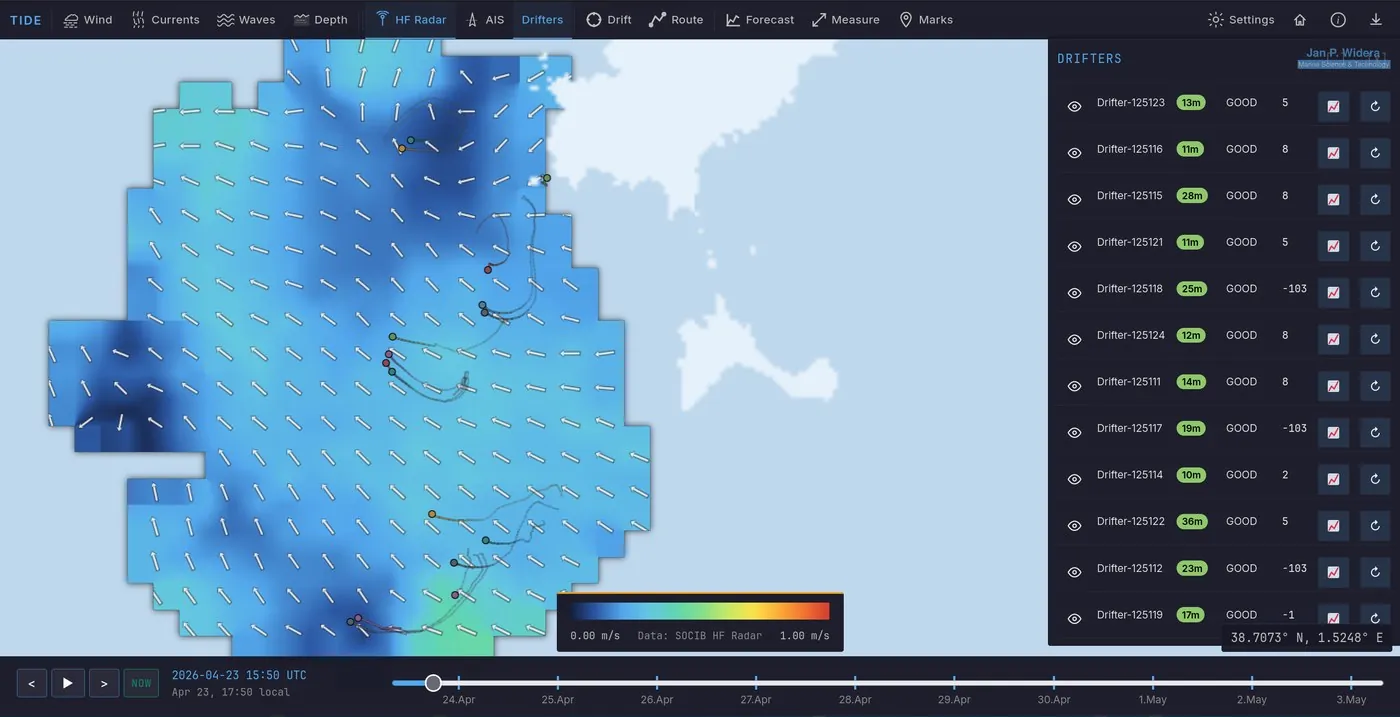
Your drifters send their position every 5 minutes. The positions are stored in a database, and you receive a dataset to derive Lagrangian drift.
How you reach it
Access is via any modern web browser or an API. We support different data formats. On request we provide individual APIs and upload routines.
What to be aware of
Trawlers and line-fishers can pick up and destroy drifters. GPS and satellite connections can drop out due to weather, jamming, or coverage gaps. We estimate these risks for your area of interest.
What does the drifter measure?
Lagrangian drift = wind drag + wave breaking + Stokes drift + Eulerian current
- Wind drag - negligible due to the 21:1 drogue-to-float ratio
- Wave breaking - normally no problem, except in very shallow water
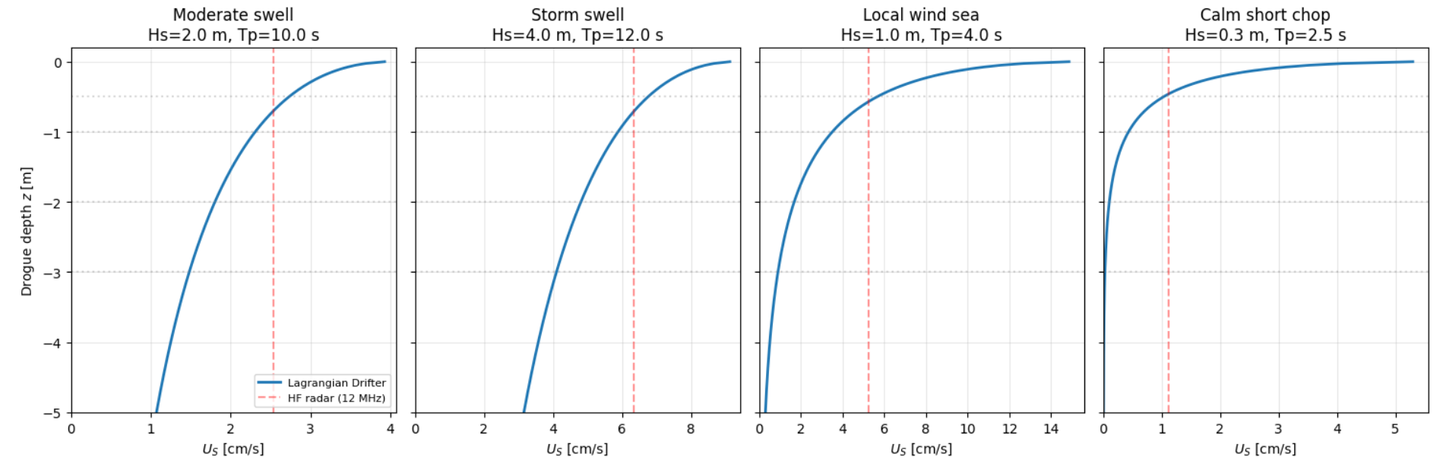
- Stokes drift - depends on waves and drogue depth; order cm/s at the surface, decays exponentially with depth
- Eulerian current - the background current
Lagrangian means following a particle in space. Eulerian means observing a fixed point. ADCPs and similar instruments are Eulerian in-situ devices. Lagrangian drifters measure the actual drift (Stokes plus background current).
Specifications
| Parameter | Value |
|---|---|
| Drogue-to-Float ratio | 21:1 |
| Measurement depth | 50 cm default, configurable |
| Position accuracy (GNSS) | 10 m |
| Median update interval | 5 min |
| Duty cycle | approx. 80% |
| Battery lifetime | up to 150 days, depending on clouds |
| Float dimensions | 20 x 7.5 cm |
| Drogue dimensions | 35 x 35 cm |
| Operating temperature | -33 to 60 deg C |
| Data transmission | LEO satellite |
What you will get
- Lagrangian drifter with glass or plastic housing, pre-assembled
- 6-month satellite subscription (activation, data, cancellation)
- Data processing: outlier removal, timestamp alignment, QC
- 1-year data storage on our server
- Data formats: CSV, MAT, KMZ, netCDF
- Live map to follow your drifters
- Video tutorials and live support (9-16 CET)
Drifters are reusable - we support battery exchange and reactivation.
Use Cases
Verify and calibrate your HF radar
Lagrangian drifters are low-cost, so they can be deployed in large numbers to verify or calibrate HF radar measurements.
HF radars measure the current via Bragg scatter of ocean waves of 5 to 50 m, depending on the radar frequency. They observe the dispersion-related current, the background current, and possibly part of the Stokes drift. Recent results suggest HF radars follow about one half of the surface Stokes drift, corresponding to an effective measurement depth (doi:10.1175/JTECH-D-21-0025.1).
Data Output
The drifters transmit position data (latitude, longitude, UTC timestamp) in real time via satellite. They store no data on board.
For other parameters (SST, waves), contact us and we help you find a suitable device.
FAQ
How long do the drifters last?
The drifters are designed for up to 150 days of battery time.
What data do the drifters collect?
Currently they record position only. We are developing a model that also records air pressure and temperature.
How accurate is the position?
Position precision is set by GNSS/GPS precision, about 10 m. Propagating this uncertainty over half an hour gives a velocity standard deviation of about 1 cm/s.
Background
Our drifter design follows established methods used in peer-reviewed oceanographic research. Selected publications using similar drifter types:
Request a Quote
Contact us for pricing and availability.