Lagrangian Ocean Drifters - Surface Current Tracking

Lagrangian Drifter HLD

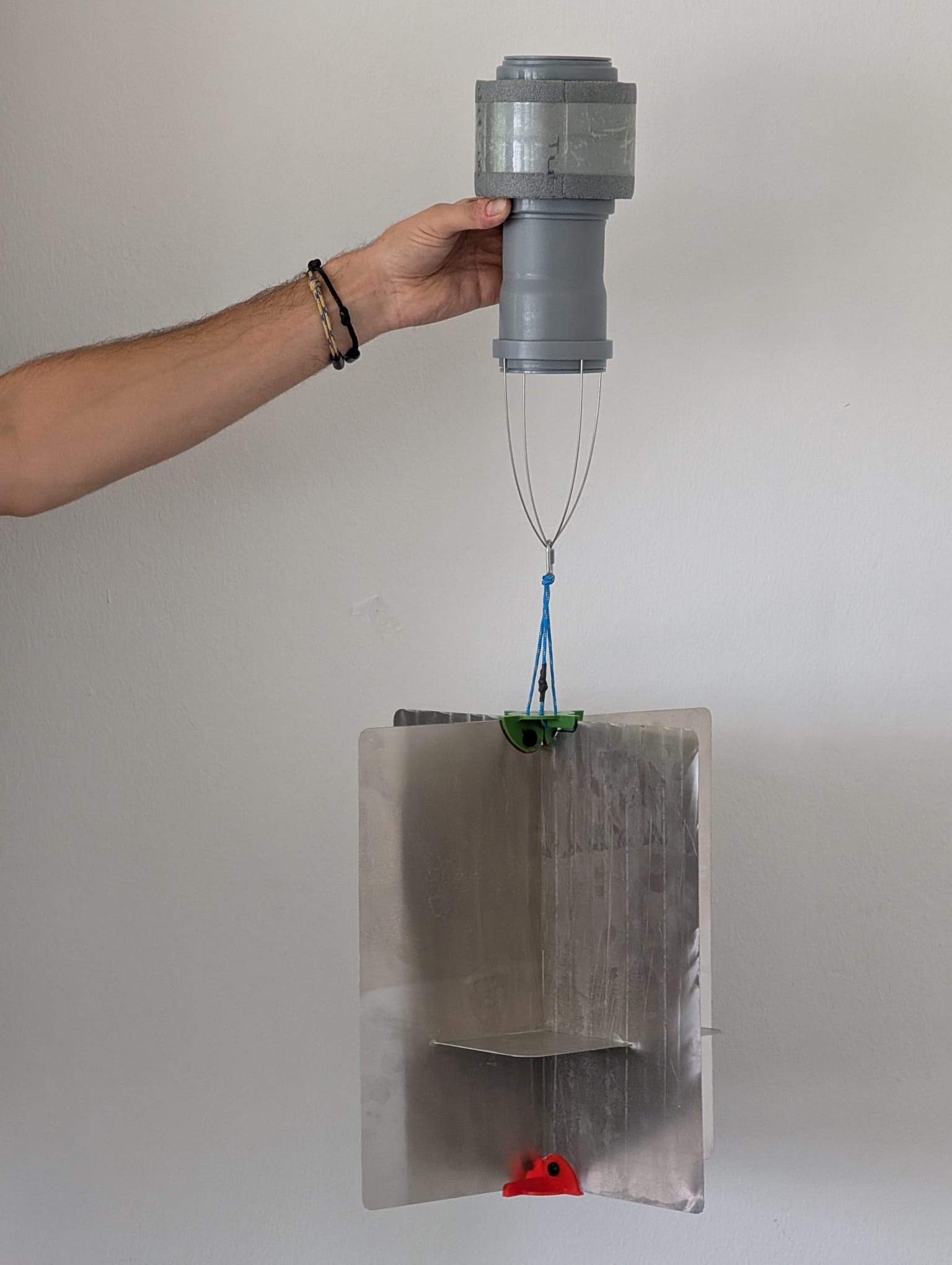
Lagrangian ocean drifter HLD buoy for surface current measurement

Surface current drifters optimized for coastal and open-ocean studies. Pre-assembled and delivered with satellite subscription, data processing, and support.

We offer two versions:

  • HLD-1 - Standard version with plastic housing
  • HLD-2 - Eco-friendly version with glass housing, significantly reduced plastic

Both versions share the same specifications and data services. HLD-2 was developed to minimize environmental impact and was deployed in The Ocean Race Europe 2025.

Specifications

Parameter Value
Drogue-to-Float ratio 21:1
Measurement depth 50 cm
Position accuracy (GNSS) 10 m
Update interval 5 min
Battery lifetime up to 150 days
Float dimensions 20 x 7.5 cm
Drogue dimensions 35 x 35 cm
Operating temperature -33 to 60 deg C
Data transmission LEO satellite

Included Services

  • 6-month satellite subscription (activation, data, cancellation)
  • Data processing: outlier removal, timestamp alignment, QC
  • 1-year data storage on our server
  • Data formats: CSV, MAT, KMZ, netCDF
  • Video tutorials and live support (9-16 CET)

Drifters are reusable - we support battery exchange and reactivation.

Data Output

Position data (latitude, longitude, UTC timestamp) transmitted in real-time via satellite. No onboard storage.

For other parameters (SST, waves), contact us - we can help you find a suitable device.

FAQ

  • How long to the drifters last? The drifters are designed for approx six months battery time.
  • What data do the drifters collect? At the moment they are only recording the position data. We are working on a new model with air pressure and temperature
  • How accurate is the position? The position precision is determined by the GNSS/GPS prescision. A handwaving number is about 10m. Propagation of uncertainty over half an hour will give you a very small standard deviation for the velocity of 1cm/s.

Background

Our drifter design follows established methods used in peer-reviewed oceanographic research. Selected publications using similar drifter types:

  • Callies, Groll, Horstmann et al. (2017): Surface drifters in the German Bight. Ocean Science, 13(5), 799-827. doi:10.5194/os-13-799-2017
  • Callies, Carrasco, Floeter, Horstmann et al. (2019): Submesoscale dispersion of surface drifters in a coastal sea. Ocean Science, 15(4), 865-889. doi:10.5194/os-15-865-2019
  • Staneva, Ricker, Carrasco et al. (2021): Effects of wave-induced processes in a coupled wave-ocean model on particle transport simulations. Water, 13(4), 415. doi:10.3390/w13040415
  • Schulz-Stellenfleth, Foerderreuther, Horstmann et al. (2021): Optimisation of parameters in a German Bight circulation model. Frontiers in Marine Science, 8, 648266. doi:10.3389/fmars.2021.648266
  • Hans, Brandt, Gasparin, Horstmann et al. (2024): Observed diurnal cycles of near-surface shear and stratification in the equatorial Atlantic. JGR Oceans, 129(8). doi:10.1029/2023JC020870

Request a Quote

Interested in our drifters? Contact us for pricing and availability.

Impressum Datenschutzerklärung